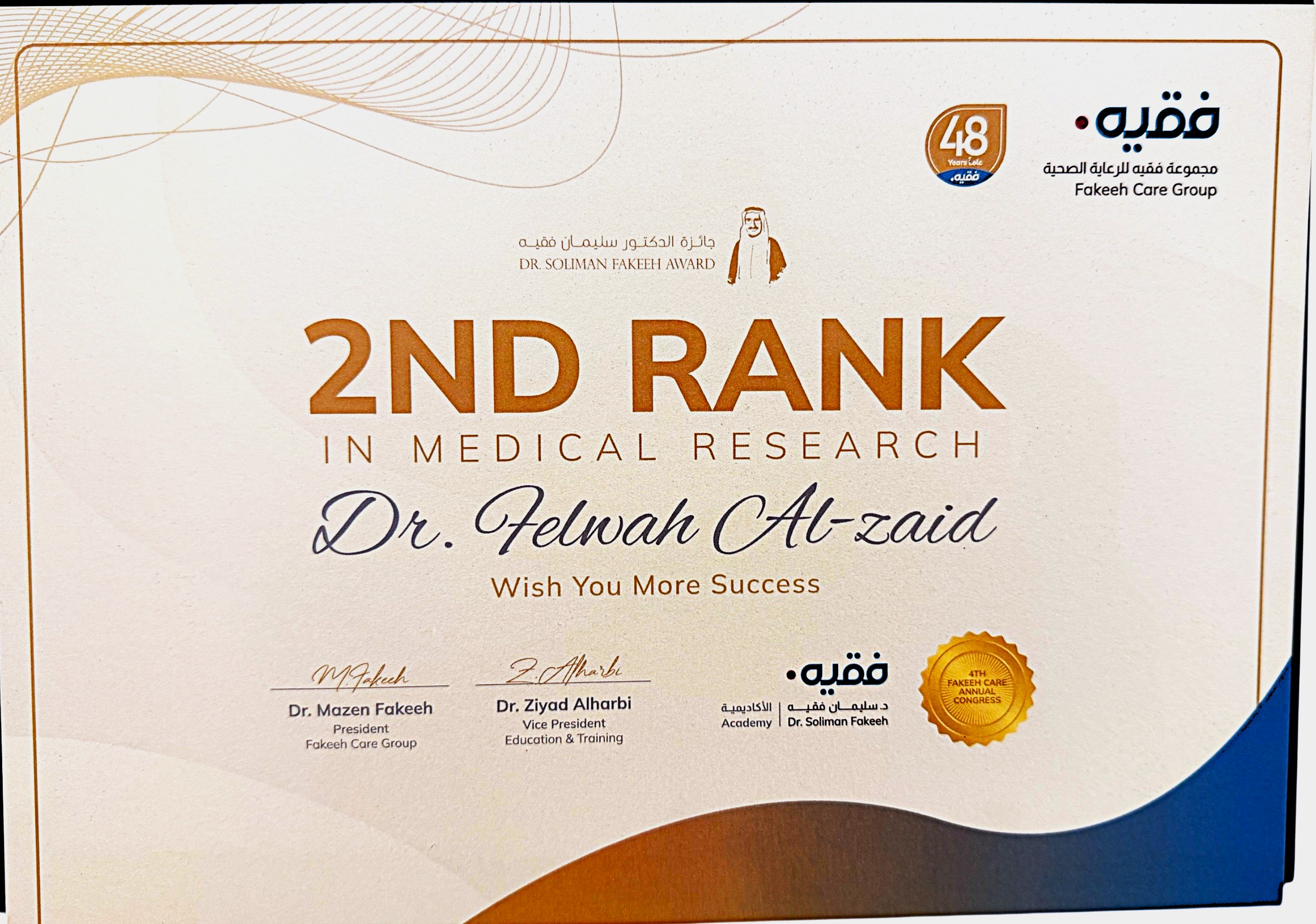
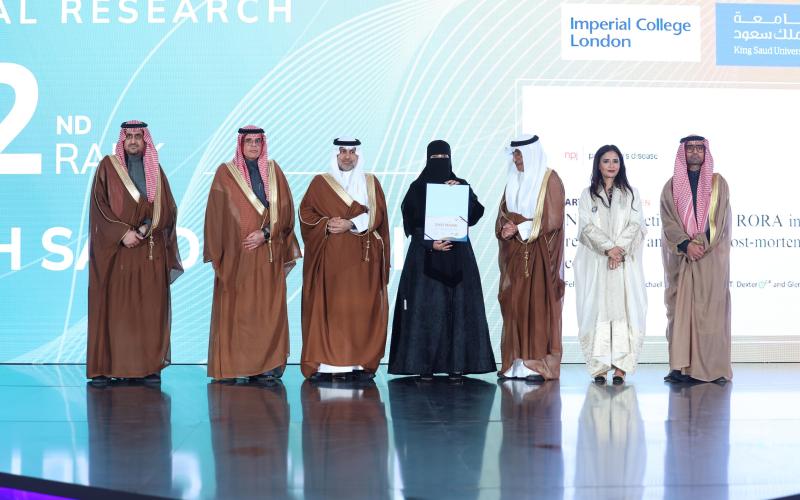
The Minister of Health Honors Dr. Flwah Al-Zaid for Winning the Dr. Suleiman Fakeeh Award in the Medical Research Track
In a distinguished research achievement, His Excellency the Minister of Health, Dr. Fahad bin Abdulrahman Al-Jalajel, recently honored Dr. Flwah bint Saad Al-Zaid, Assistant Professor in the Department of Physiology at the College of Medicine, for winning second place in the Dr. Suleiman Fakeeh Award for Medical Research, Innovation, Health Education, and Medical Education, in its fourth edition (Medical Research Track), for her scientific study entitled: “The Neuroprotective Role of the RORA Gene in Parkinson’s Disease: Revealed Through Analysis of Post-Mortem Brains and Dopaminergic Cell Lines.” This took place during his patronage of the Fourth Annual Conference of Fakeeh Care Group, held in partnership with the Saudi Commission for Health Specialties and organized by Fakeeh Care Group in the city of Jeddah, in the presence of a distinguished group of health leaders, experts, and practitioners from various health specialties. The award is considered one of the prestigious scientific awards that aims to support scientific research and innovation in health and medical fields and to encourage researchers to present scientific solutions that contribute to improving the quality of healthcare.
For her part, Dr. Flwah Al-Zaid explained that the research addressed the scientific explanation behind the higher incidence rates of Parkinson’s disease among men compared to women, through the study of a specific gene that showed higher levels in women, leading to the conclusion that this gene plays a protective role in reducing the risk of the disease. She noted that this study is the first of its kind to describe the levels and presence of the RORA gene in the brain region known to be affected during Parkinson’s disease, based on the analysis of post-mortem brains and dopaminergic cell lines—an aspect that has not been previously documented scientifically. She further explained that the research findings were translated into the discovery of a promising therapeutic approach through the use of an experimental drug on a cell culture model simulating Parkinson’s disease, which demonstrated the ability to increase the level of gene and protein expression of this gene and significantly contributed to protecting nerve cells from disease progression, in addition to precisely characterizing the mechanism of action of this protective effect, concluding the positive outcomes of the study.
This award embodies the research excellence and distinguished scientific contributions achieved by the College of Medicine at King Saud University, reflecting the College’s support for the research ecosystem and the empowerment of national competencies in the medical and health fields.